
How To Travel From Quito To The Galápagos Islands
Traveling from Quito to the Galápagos Islands is like leaving the Andes behind and entering a wildlife paradise. Because there are no ferries from mainland Ecuador, flying is the only way to get to the islands.
There are flights from Guayaquil (GYE) or Quito (UIO), but we focus on the latter, Ecuador’s high-altitude capital. Regular flights depart Mariscal Sucre International Airport to Baltra or San Cristóbal, taking three to four hours.
We flew from Quito to San Cristóbal and returned from Baltra. In this guide, I explain how to choose the right flight, what documents you need, and how to island-hop once there.
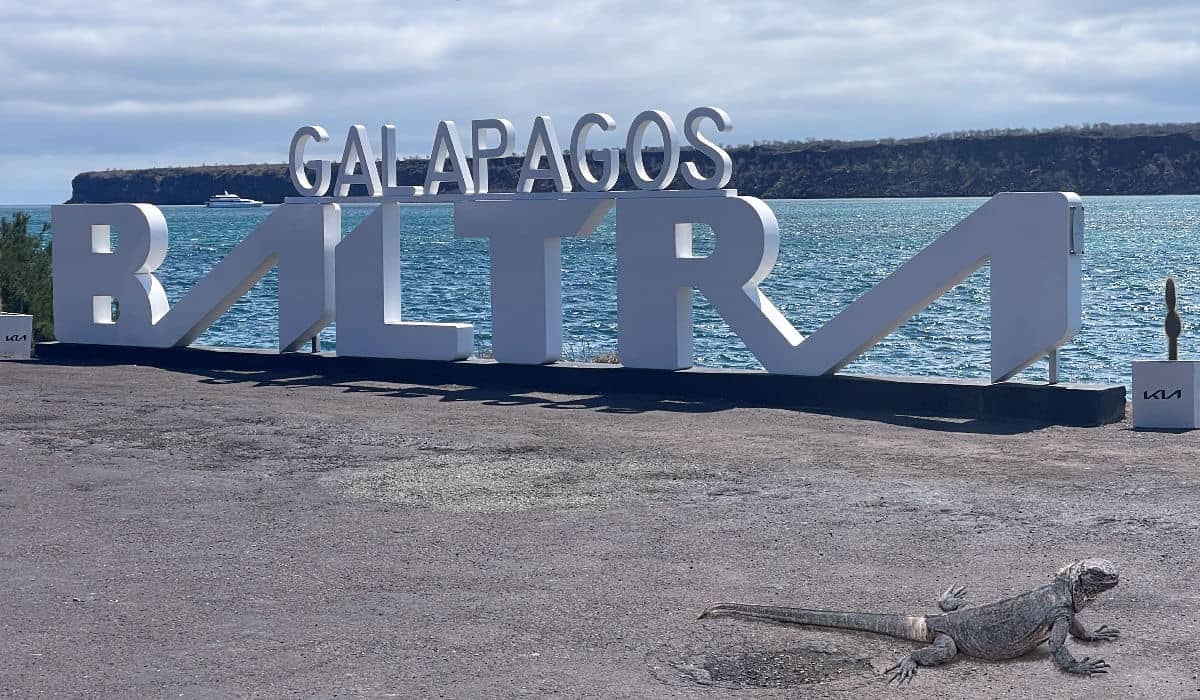
Traveling From Quito To The Galápagos Islands
The journey from Ecuador’s capital to the archipelago spans approximately 830 miles across the Pacific Ocean. On a map, it appears much closer. Ecuador first time visitors are wise to do some research before their arrival.
Geographical Distance And Location
Quito sits 9,350 feet above sea level in Ecuador’s Andean highlands, almost on the equator in the north-central region. The city attracts travelers seeking culture, history, and dramatic mountain views.
The Galápagos Islands lie about 600 miles west of Ecuador’s coast in the Pacific, with 13 major islands and many islets across roughly 17,000 square miles. It is one of the world’s most remote destinations.
Airlines operating this route typically make a brief stop in Guayaquil before continuing to the Galápagos.
Travelers can also fly from Guayaquil as an alternative, which is closer to the islands and reduces total flight time. That flight takes 1 hour and 35 minutes.
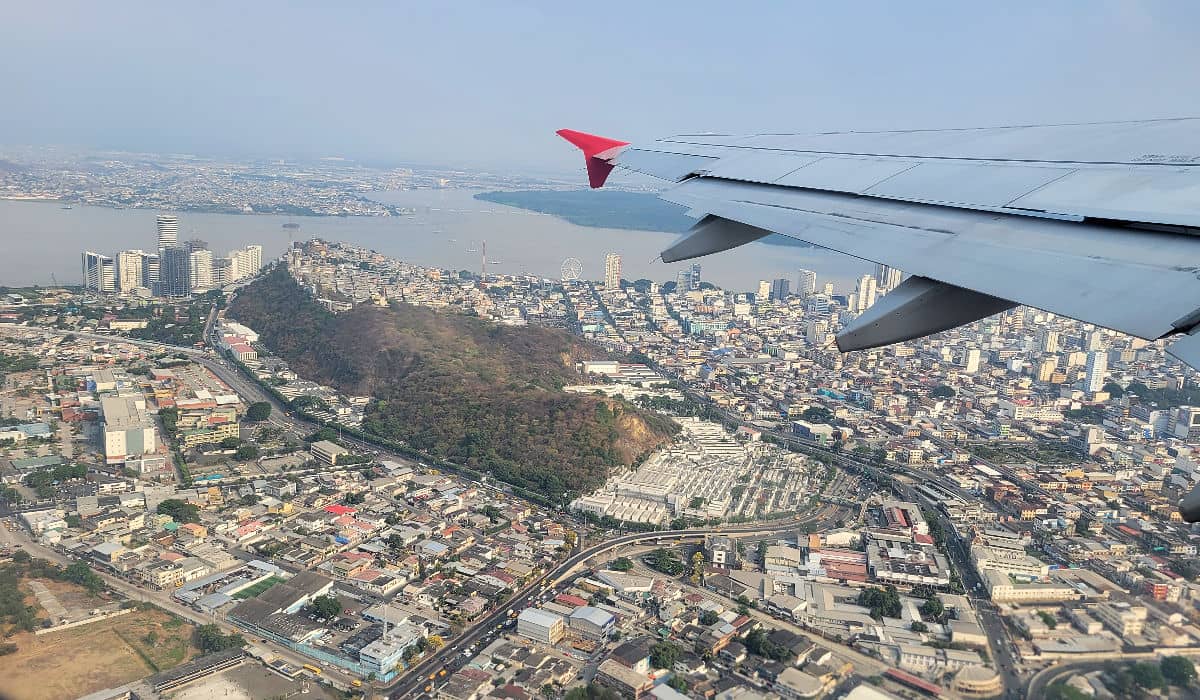
Time Difference
The Galápagos Islands operate on Galápagos Time (GALT), which is UTC-6. Quito uses Ecuador Time (ECT), set at UTC-5. This creates a 1-hour time difference, with the islands 1 hour behind mainland Ecuador.
Recommended Airlines And Booking Platforms
Two leading carriers operate flights between mainland Ecuador and the Galápagos: AVIANCA and LATAM Airlines. Both provide multiple daily departures from Quito’s Mariscal Sucre International Airport.
Booking options are available directly on each airline’s website or through comparison platforms to find the best fares. Avianca is part of Star Alliance, for those who collect airline points.
Both airlines have a luggage limit of one checked bag weighing up to 23 kg (50 lbs.) and a carry-on up to 10 kg (22 lbs.). An additional bag is USD 100. Avoid packing plants, fresh food, and seeds. Security suggests packing medications in their original containers, with prescriptions.
Most flights from Quito make a 45-minute fueling stop, and passengers stay on board during the brief Guayaquil layover.

Airfare from Quito to the Galápagos Islands can vary. Expect to pay USD 400-600 in peak season (June to August and December to January). During shoulder months like April, May, September, and November, prices drop to USD 300-450 round-trip.
We flew with AVIANCA, had an 8 am departure, and a travel time of 3 hours and 40 minutes. Since we were required to be at the airport 2 hours before, it meant we had a very early start. We returned on LATAM Airlines and traveled from Baltra to Quito. Travel time was 3 hours 25 mins.
Although our tour company booked us into economy, we could upgrade for under USD 30 pp. Upgrading provides more leg room and an empty middle seat.
Entry Requirements And Travel Documents
Traveling to the Galápagos Islands from Quito requires specific documentation and fees that all visitors must complete before departure.
We needed a valid passport, a Transit Control Card, and pay National Park entry fees upon arrival. Since the online declaration form was glitchy, we used the paper version on the plane.

Galápagos Transit Control Card
The Transit Control Card (TCT) is a mandatory document for all tourists visiting the Galápagos Islands. As of May 2025, the Governing Council of the Galápagos Islands implemented a new online registration system for the TCT.
TCT costs USD 20 per person and is non-transferable. It can be purchased at the airport in Quito or Guayaquil before boarding. When purchasing, we needed our valid passports and flight confirmation. The card serves as a biosecurity control measure to protect the fragile ecosystem of the Galápagos.
However, the new online system allows advanced registration. Our airline ticket must show round-trip travel, and we cannot stay on the islands for more than 60 days.
We tried filling out the online form several times, but since it’s new, it had a few hiccups. The number of nights in our hotels didn’t match the number of days on the islands, even though we input the information correctly. If you find the form glitchy, complete the paper version instead.
National Park Entry Fees
The Galápagos National Park entry fee is paid upon arrival at the airport, separate from the TCT.
Foreign adults pay USD 200, and children under 12 pay USD 100. Fees are paid in cash upon arrival. Our large bills ($100s and $50s) were accepted despite recommendations to use small bills.
We kept our receipt as proof of payment, since park rangers could request to see it at various visitor sites throughout the islands. The fees directly support conservation efforts and park management.
Passport And Visa Policies
US citizens and most international visitors do not require a visa for Ecuador, including the Galápagos Islands.
No vaccinations are legally required for entry. However, since our trip included a visit to the Amazon, our doctor recommended vaccines for Hepatitis A, Hepatitis B, Yellow fever, Malaria, and Typhoid.
Mariscal Sucre International Airport (Quito)

Mariscal Sucre International Airport sits in Tababela, approximately 11 miles east of Quito’s city center. The airport requires travelers to arrive at least 2 hours before domestic flights.
Ground transportation from central Quito to the airport takes 45 minutes to 1 hour, depending on traffic. We traveled by private transfer arranged by our tour company. Many hotels offer airport shuttles, or you can use a taxi or Uber instead.
At the airport, it was odd that we could take liquids through security. However, shoes had to be removed and scanned separately from our carry-on.
After obtaining a Transit Control Card, we had our luggage scanned through an agricultural inspection to prevent invasive species from reaching the islands. Our luggage was then zip-tied.
Even though the flights are short, they offer bottled water at the rear of the plane and a selection of items for purchase. There was no complimentary Wi-Fi.
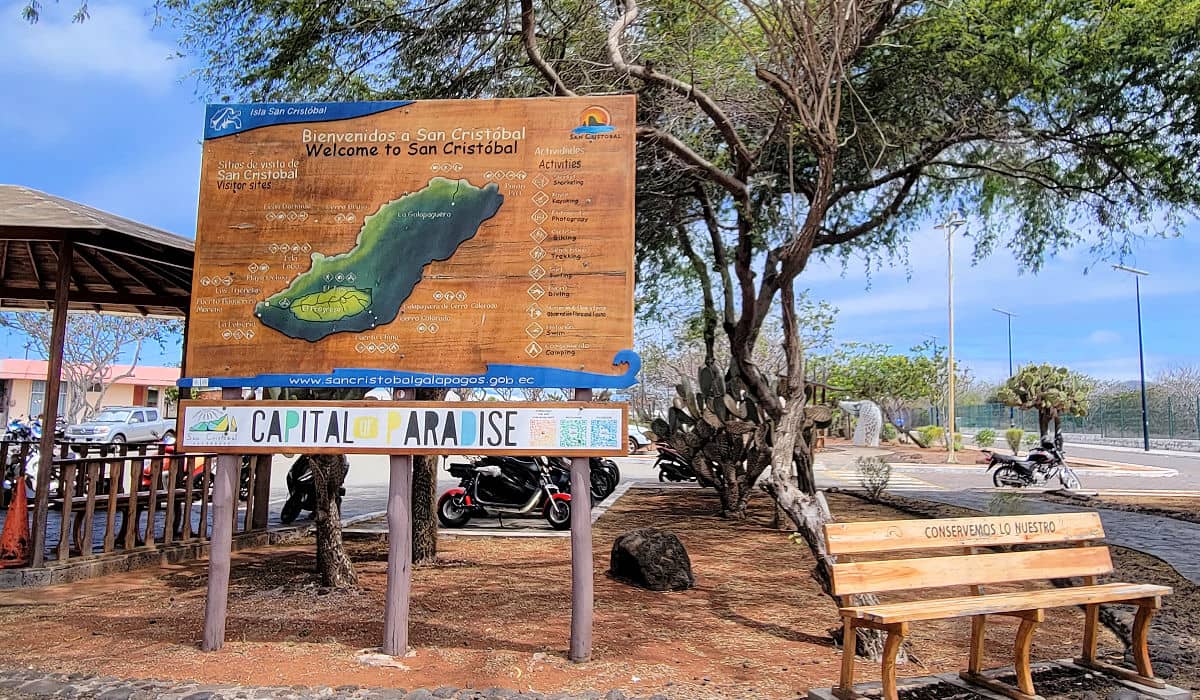
Just before arriving in the Galápagos, all baggage in the overhead bins was sprayed with an insecticide.
Seymour Airport (Baltra) And San Cristóbal Airports
The Galápagos has two airports receiving flights from mainland Ecuador: Seymour Airport on Baltra Island and San Cristóbal Airport. Seymour Airport on Baltra handles most incoming flights and serves as the main gateway to Santa Cruz Island.
Both airports are tiny with one short runway. I was amazed to see our plane brake and run to the very end of the tarmac, then do a U-turn and return to the terminal. It was the first time I had disembarked from the back of the plane.
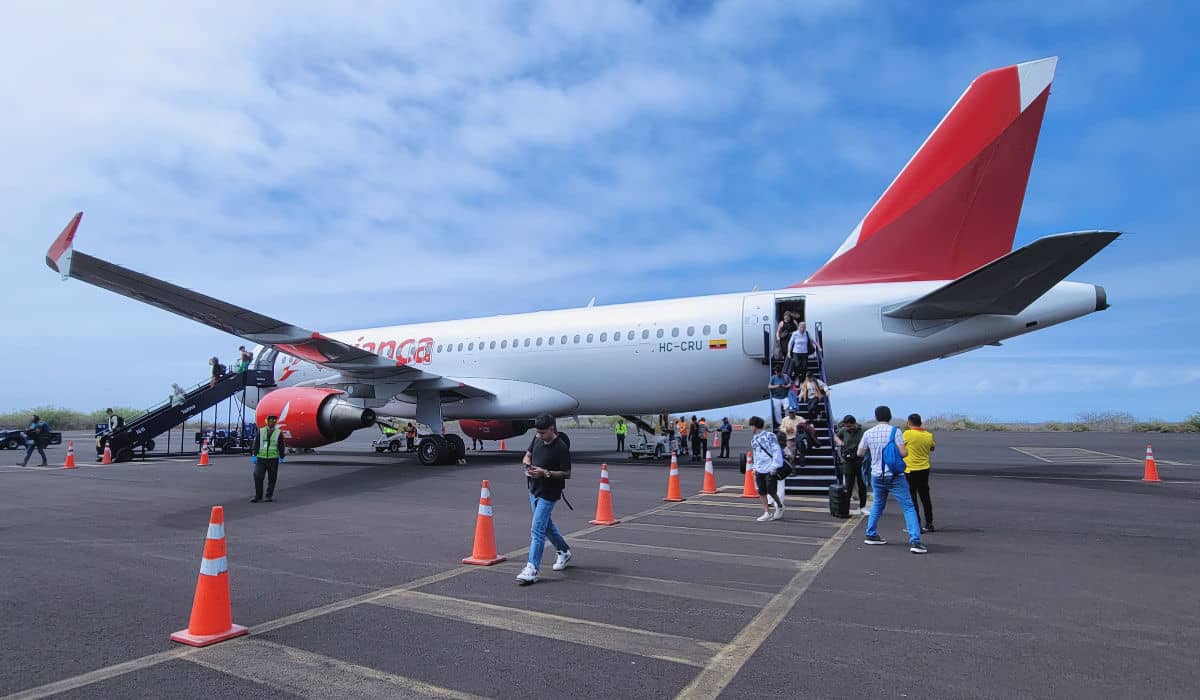
Once luggage was unloaded, zip ties were removed and the dog patrol sniffed them before collection.
Upon landing, we must pay the Galápagos National Park entrance fee. From Baltra, it’s a short bus ride to the Itabaca Channel, then a 5-minute ferry crossing to Santa Cruz Island. The entire transfer to Puerto Ayora takes approximately an hour.
San Cristóbal Airport, where we landed, offers a more direct arrival for travelers staying on that island. This smaller airport sits right next to Puerto Baquerizo Moreno, making it a short taxi ride or walk to town accommodations. San Cristobal’s hotels are more concentrated with a walkable downtown area.

Both airports have small facilities with limited services. We recommend carrying snacks and water, although Baltra has a small food court area.
Tips For Staying In The Galápagos
Ecuador and the Galápagos use the US Dollar. Bring cash in small denominations, as taxis cost $2 per ride and meals are often $6 or more.

ATMs are available in Puerto Ayora on Santa Cruz Island and Puerto Baquerizo Moreno on San Cristóbal Island, but they’re limited and sometimes run out of cash.
Larger hotels, restaurants, and large tour operators accept credit cards. However, smaller establishments, local shops, and street vendors accepted cash only. We suggest withdrawing cash before leaving Quito, where ATMs are more reliable and numerous.
Communication And Connectivity
We had no problems with service in Puerto Baquerizo Moreno (San Cristóbal) and Puerto Ayora (Santa Cruz). However, when we ventured away from the city, service was spotty or nonexistent.
Consider purchasing a local SIM card in Quito if you need reliable data access. Brian used an Airalo eSIM, and I used a GigSky eSIM to compare their service. Both were affordable, and we enjoyed good service throughout our stay.
Ready to save money on Wi-Fi?
Purchase your eSIM with GigSky. Use the code FOREVERKAREN to save 10% off your first purchase.
Island Hopping
The Galápagos Islands are a popular destination for cruising in South America. While expensive, we found it more affordable to stay in hotels and island hop.
From populated islands like Santa Cruz, San Cristóbal, or Isabela, it’s possible to take day trips to nearby sites. This option offers greater flexibility and affordability than live-aboard cruises. Each Galápagos Island offers unique activities and wildlife watching.
Public speedboats operated by Gaviota Ferry travel daily between Santa Cruz, San Cristóbal, and Isabela. The boats depart in the morning (usually between 7 am and 3 pm) and cost USD 25-40 per person one-way.

Our boat ride from San Cristóbal to Santa Cruz took under 2 hours and cost USD 35. The journey was choppy, so we recommend seasickness medication. Other fast ferry options include:
|
Ferry between islands |
Ferry cost |
|---|---|
|
Santa Cruz and Isabela |
USD 35 |
|
Santa Cruz and Floreana |
USD 40 |
Floreana water taxi to the pier costs $1.50 and there’s an additional $10 entry fee.
Small planes also operate between Baltra, San Cristóbal, and Isabela through Emetebe Airline, offering a faster but more expensive alternative at approximately USD 180-200 per flight.
Flying To The Galápagos Final Thoughts
Traveling from Quito to the Galápagos is straightforward once we understand the steps. Book the right flight, complete paperwork early, and plan your island transfers. Arrive with cash, pack smart, and allow extra time at the airport.
Knowing Spanish is an added advantage to filling out forms and completing the entry requirements at the airport. Since we knew no Spanish, we used Google translate or recommend downloading an app.
Once there, the islands rewarded us with unique wildlife, warm water, and easy access to tours. The Galápagos Islands had been on our bucket list for a long time, and our trip with Exoticca Travel exceeded our expectations. We felt like we were immersed in a National Geographic documentary.
