
Arundel Castle And Gardens, A Must-See In West Sussex
Nestled in West Sussex, Arundel Castle is one of England’s best-preserved medieval landmarks. Nearly 1,000 years old, it’s long been home to the Dukes of Norfolk. Today it showcases Norman architecture, Victorian grandeur, and stunning gardens.
Whether you’re into history, gardens, or a day trip from Brighton or London, Arundel Castle delivers. Climb the 12th-century Keep for South Downs views, tour opulent State Rooms, and wander 40 acres of gardens. Don’t miss the striking Collector Earl’s Garden, our favorite spot on the grounds.
The castle also hosts many events, from medieval jousting tournaments to theatrical performances and seasonal flower festivals. With plenty of family-friendly activities, thoughtful amenities, and the charming town of Arundel just steps away, it’s no surprise it’s a wonderful place to visit in south England.
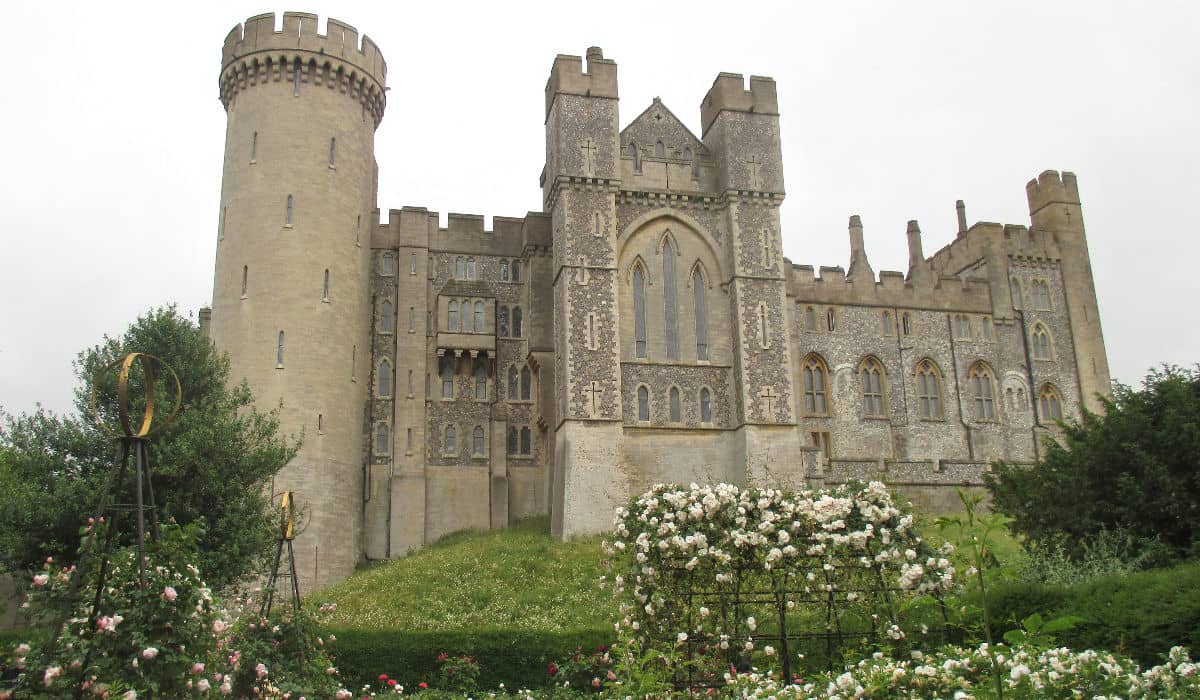
In this guide, you’ll find everything you need to plan the perfect visit: how to get there, ticket options, can’t-miss sights, and insider tips. A day visit provides insight into one of England’s most impressive castle homes.
Getting To Arundel
Driving is straightforward via the A27: from London, take the M25 then A3 toward Portsmouth and join the A27 westbound toward Arundel. There’s roadside parking and a pay-and-display lot just opposite the castle.
Alternatively, the train from Victoria station takes the same amount of time: 1 hr 30 mins. Although. expect a 15 minute walk to the castle.
Tickets And Pricing
Arundel Castle pricing depends on how much you want to see. The Gold Plus ticket covers gardens, castle, and bedrooms. A cheaper option includes just the castle and gardens. The lowest price is for garden-only access.
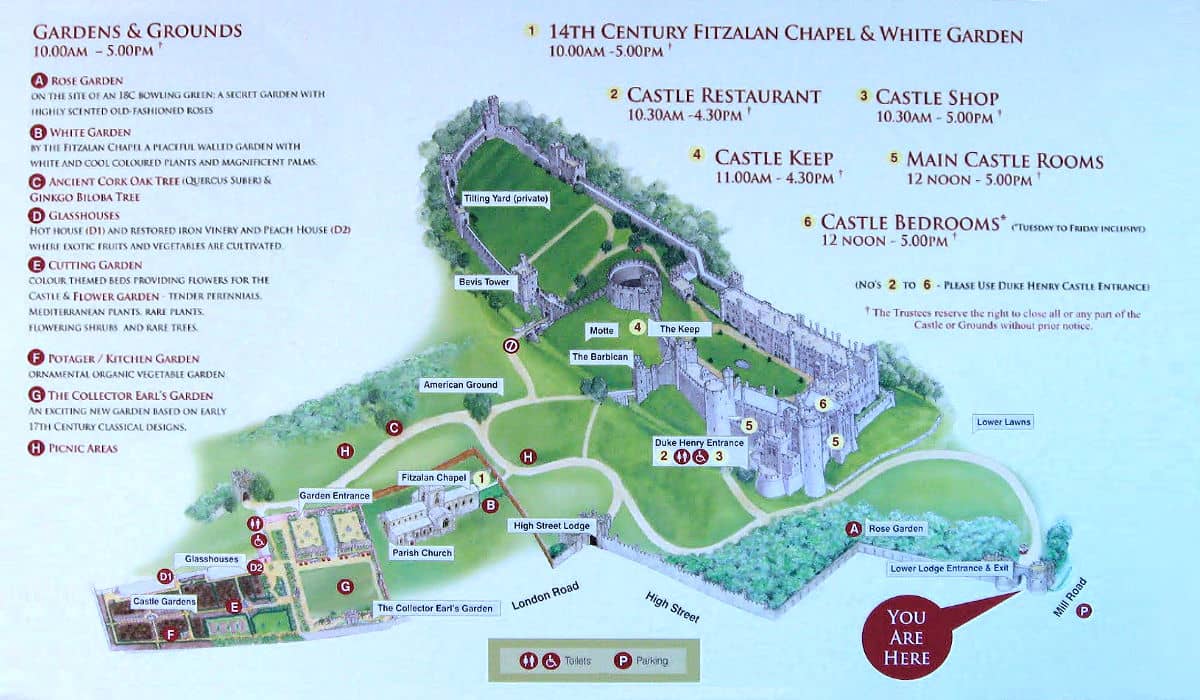
The recommended time to see all of Arundel Castle and Gardens is 4 hours, although we spent 5.5 hours. While the gardens open at 10 am, the castle itself welcomes guests two hours later. The last admission is 4 pm and the castle and gardens close at 5 pm. Do note, the castle is closed on Mondays.
Arundel Castle Grounds
Walking the path to the castle, we were blown away by such an impressive structure. While it wasn’t the quintessential structure like Leeds Castle with a surrounding moat, it still wowed us with its dominating facade.
During our visit, the rose garden was in bloom and made for such a picturesque setting. We arrived a little too early to gain access to the castle, so we passed the time by wandering the fragrant grounds.
Fitzalan Chapel
The Fitzalan Chapel is located inside the end of a church built on the castle grounds. It is part of the church of St Nicholas. It is unique because the church is divided into two worships; one part Catholic and the other Anglican. A first for a church, I think?

Founded in 1380 by the 4th Earl of Arundel, the chapel still serves as a burial place for the Dukes of Norfolk. Although the chapel is small, it has many sculpted tombs and monuments. The chapel itself is an excellent example of Gothic architecture with its stunningly carved wooden roof.
Allocate enough time to appreciate the intricately marble-carved stone tombs and the beautiful stained glass windows. The wooden carved choir stalls were the highlight.
Arundel Castle Gardens
While I’m not a gardener, the grounds of Arundel Castle blew me away. The gardens cover 40 magnificent acres, consisting of a vinery, an organic kitchen garden, a cut flower garden, the Earl’s garden, and glasshouses.

Adjacent to the chapel, a white garden features snow-white lilies, Cosmos, and Iceberg roses. Outside the gardens, the magnificent Arundel Cathedral overlooks the grounds.
The Collector Earl’s Garden was added to the grounds in 2008 and opened by Prince Charles. This formal area with its domed pergolas, Oberon’s Palace, and jetted fountains was my favorite outdoor space. Even though I’m not a gardener, I could appreciate the work and attention to detail in this stunning landscape.
This area was created in honor of Thomas Howard, the 14th Earl of Arundel. Its design was selected to represent a garden from the London residence of Arundel House.
Even though the Collector Earl’s garden was quite formal and reminiscent of Elizabethian times, other areas are very organic and allow wildflowers to flourish.
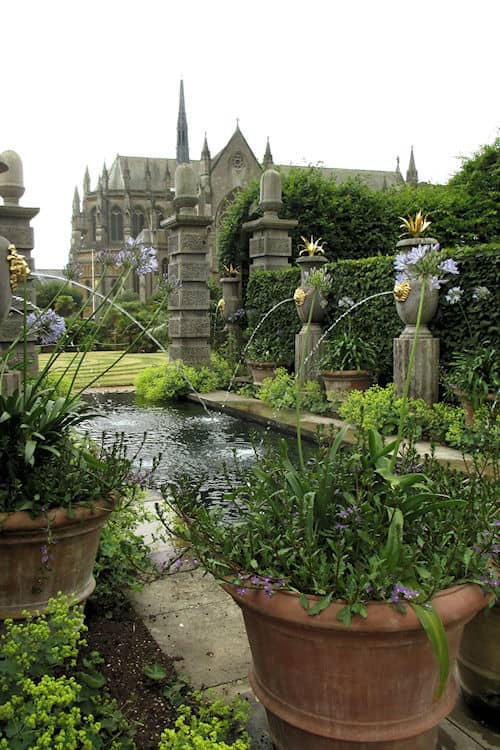
The Stumpery garden is a classic example of a Victorian informal plot. The twisted and organic elements of tree stumps mix beautifully with tones of greenery. By allowing weeds and plants to self-seed, the quirky garden contrasts greatly with the more formal areas between the castle and the Arundel Cathedral.
The tropical glasshouses are a delight too. We were fascinated by the different types of peppers, bananas, passion fruit, and grapes hanging from the vines. Home cooking couldn’t be any better with freshly picked ingredients from the castle garden.
While we came to see the imposing castle, we were pleasantly surprised by what we found in the stunning gardens. Since the walled garden provides protection from the elements, you’ll find some rare plantings within the walls.

Martin Duncan, the head gardener oversees a team of more than a dozen people to maintain the castle gardens. Each year, Mr. Duncan and his team plant over 100,000 bulbs creating a sea of tulips below the towering castle.
The Norman Keep
For many visitors, the Norman Keep is the most striking and memorable part of Arundel Castle. Dating back to the 11th century, it remains in remarkably good condition despite its age. To reach the Keep, we passed through the 1070 Gatehouse and beneath the impressive Portcullis, made of heavy oak.
This Portcullis, once served as a vital defensive feature, protecting the castle’s main entrance during times of attack. Using guide slots built into the surrounding stonework, guards could lower the gate with the help of counterweights and a winding mechanism, effectively sealing off access to the fortress.
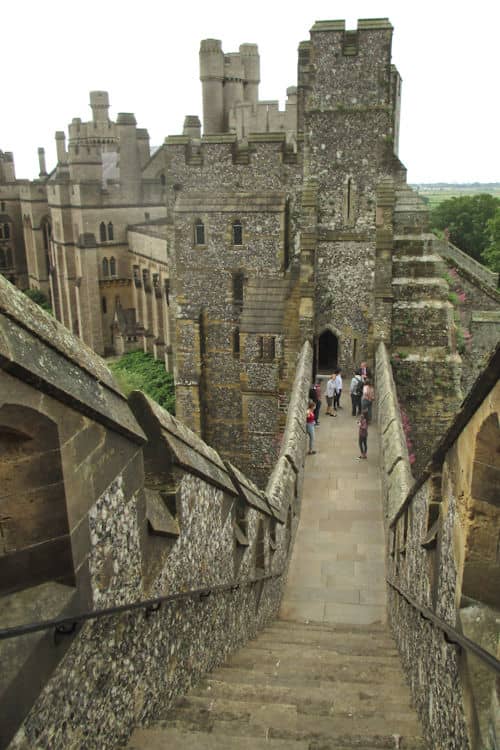
Climbing the 131 steps to the top of the Keep is no small feat, definitely not for the faint of heart. I accompanied my mother, who was in her late 70s, helping her along the way.

The steps start out fairly wide but become increasingly narrow as you ascend. At some points, barely half a foot could fit on a single tread. Fortunately, my tiny feet gave me an advantage—I was able to navigate the climb like a mountain goat.
At the top of the 30-foot tall keep, the stunning views of Arundel’s surrounding town, the River Arun, and the rolling hills of the West Sussex countryside came into view. Equally impressive are the views of the castle wards or inner courtyard, which remain closed to the public.
To one side the Barbican provides access to the lower ward nearest the castle apartments. n the other side, the 14th-century Bevis Tower, once called the Beaumont Tower leads to the upper ward. These areas are reserved for the Duke of Norfolk’s family.
Arundel Castle’s Keep is such a magical place that I almost didn’t want to leave. However, with so much more to see, I needed to continue my adventure.
Inside Arundel Castle
The castle is immaculate and an art lover’s paradise with its rare collection of paintings by renowned artists, including Van Dyck, Gainsborough, and Canaletto. Everything inside the castle is on a grander scale and finely preserved.
Baron’s Hall
At 113 feet long and 35 feet wide, the Baron’s Hall (or Great Hall) is larger than some people’s entire homes. Entering the room, I stood in awe of its enormous size. The heightened ceiling is crafted from chestnut oak in a Gothic style, typical for its time.
The antiques are pretty impressive in this space. One of the things that stood out to me was the enormous stone fireplaces that towered over me. Imagine a fireplace so big that I could stand inside of it.

Flanking the fireplaces and continuing down the walls were a series of beautiful portraits and delicate tapestries. There was so much to enjoy from floor to ceiling, including the painted window depicting the signing of the Magna Carta.
Walking through the Baron’s Hall, it’s fantastic to know the Duke and Duchess of Norfolk still use the room today. Closing my eyes, I could imagine the grand parties hosted here.
Two pieces that fascinated me were an ornate sleigh that seemed too beautiful to use and an old Chinese single-person litter adorned in black velvet. Litters are wheelless vehicles, used for centuries to transport people.

The Library
Another equally awe-inspiring space within Arundel Castle is the magnificent two-story library. It stretches an impressive 122 feet in length. Lined with rich mahogany paneling and adorned with exquisitely detailed carvings, this room exudes timeless grandeur.
Suspended from the high ceilings, delicate Chinese lanterns adorn the room featuring the collection of more than 10,000 books. These include several rare volumes and first editions. It’s a room that feels like it belongs in a Harry Potter film—magical, refined, and quietly majestic.
The deep jewel tones, from the woodwork to the plush red velvet chairs, create an atmosphere both elegant and inviting. It’s the kind of place that made me want to settle in with a good book and lose track of time.
Much of the library’s historic richness can be traced back to Thomas Howard, the 14th Earl of Arundel. A passionate collector during the 17th century, he amassed an exceptional collection of paintings, classical sculptures, and literary works. Some in the library today offer a direct link to his legacy.

The Private Chapel
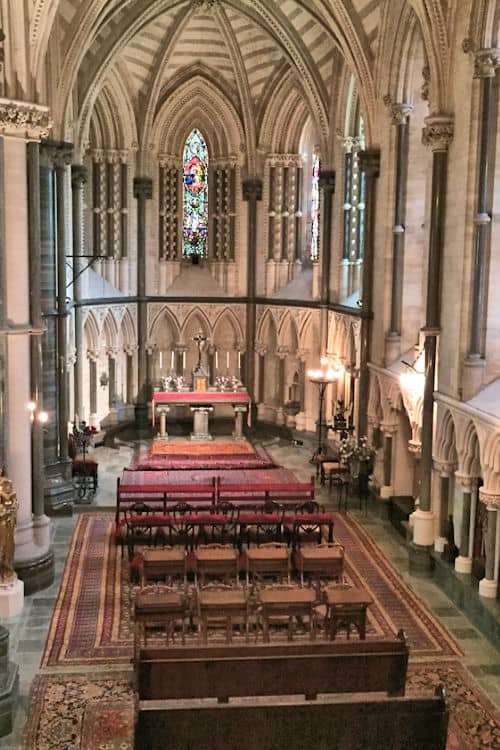
Constructed between 1890 and 1903, with inspiration from Salisbury, one of Britain’s best cathedrals, visitors can’t tour the private chapel.
While we couldn’t walk through, we could enjoy views from the walkway above. The Private Chapel is closed to the public because it is used exclusively by the family for special occasions such as christenings and mass.
The Private Chapel was used daily for family and household morning and evening prayers in the early years of the 20th Century and Mass was celebrated here on Sundays and feast days until c.1960 when the shortage of priests compelled regular Mass here to cease.
We mavelled at the early English Gothic architecture. The stained glass is superb and mimics those at Canterbury Cathedral. Purbeck marble was extensively used in the construction of the chapel, giving it a monarchical feel.
Queen Victoria’s Bedroom
Touring the castle rooms, we realized Arundel is not just a stately home and a magnificent castle. It’s also a museum of incredible tapestries, oil paintings, and intricate antiques.
Victoria’s bedroom, for instance, is the epitome of royalty with its gold accents and luxurious fabric choices. While the Queen stayed at Arundel a mere three days in 1846, her bedroom and certain castle rooms were extensively refurbished so they weren’t drafty or unappealing.
For a well-earned break, the café offers the perfect spot to enjoy a meal in a medieval dining room setting. The smoked mackerel salad was both reasonably priced and delicious.
The Grand Staircase
For many, the castle’s library and Norman Keep are favorites among those visiting the castle estate’s interior. However, a few other areas captivated me; firstly, the Grand Staircase, and secondly, the Drawing Room.

The Grand Staircase leads from the main level to the additional bedrooms only accessible with my Gold Plus ticket. The Grand Staircase is a visual splendor with a collection of paintings on one wall and a colossal 18th-century tapestry on the other.
It was hard not to ogle at the intricately carved stone railings and decorative moldings paired with ancestral portraits. Equally stunning are the beautiful stone ceiling and beautiful ceiling bosses.
The Drawing Room
Although lavish in style, the Drawing Room felt homey and a great gathering spot for the family. The Drawing Room’s centerpiece is a larger-than-life carved chimneypiece depicting the Coat of Arms of Henry Fitzalan-Howard. The ceiling cornices display additional Coats of Arms.
Like every other room in the castle, the family decorated it with ornate furnishings and luxurious fabrics. Since wedding family photos adorn the ornate furniture, it’s obvious, that the family still actively uses the room. There were even photos of the Queen and Prince Phillip and also one of the Pope.

Over the years, the Sussex Castle has served as a backdrop to many film productions. These include Dr. Who, the 1994 film “The Madness of King George” and the 2009 movie “The Young Victoria.”
Final Thoughts
If you’re searching for a fantastic day trip and want to take in some history, be sure to spend a day visiting Arundel Castle. You might be pleasantly surprised by what you discover.
Throughout the year, the estate holds festivals and events, with the tulip festival, being a gardener’s favorite. The jousting event also provides great fun for families.
Beyond this magnificent home, travelers can find some amazing castle ruins worth visiting too. Bodiam Castle in East Sussex is a great example.
A 20-minute drive to the west, guests can view a stunning collection of mosaic floors at Fishbourne Roman Palace ruins. Once a magnificent Roman Palace with 100 rooms, you’ll learn its history, see its marvelous infloor heating system, and admire its mosaics.

Beautiful to see the ancestral home of my great grandmother’s uncle; the Duke of Norfolk. That
makes me a kinsman also. How enchanting, indeed!
My great grandmother name was Catherine Howard.
She could trace her lineage back to King Henry Vlll
and her unlucky cousin; also a niece of the Duke of Norfolk in those Shakespearean days, who was the
King’s 5th wife. She was beheaded.
Wow, you have amazing lineage and fascinating history, so thank you for sharing that. Arundel Castle is a spectacular place that blossoms year by year, and I hope you get to visit often.
Lovely website, I used to work there as a guide until about 4 years ago. It was a happy place to work.
Thank you, David. I have enjoyed visits to Arundel Castle and seen big changes in 30 years. What great memories you must have from working in such a prestigious home.